

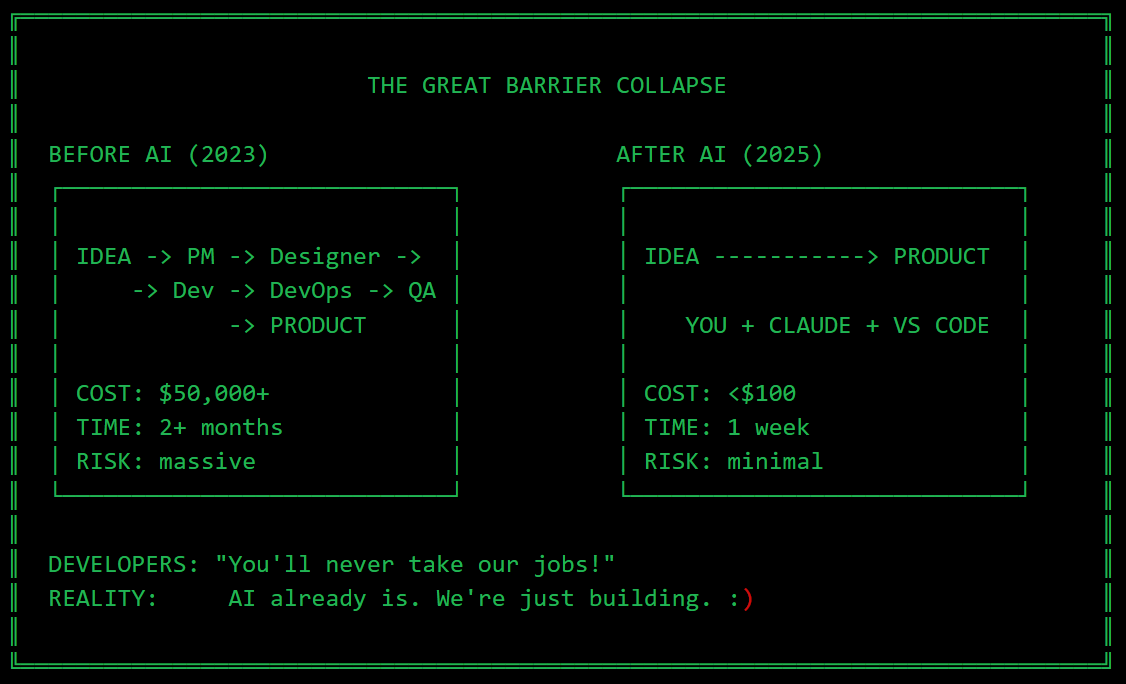
The Developer Meltdown
Developers are losing their minds right now. The reactions range from nervous laughter to outright insults, and their main argument sounds like a cope:
“People like you will never take our jobs.”
Here’s the thing though—people like me aren’t trying to take developer jobs. That would be stupid. Why would anyone in their right mind pursue a developer career in 2025 when AI is about to automate the entire profession? The irony is beautiful: vibe coders aren’t competing for programming positions. We’re building products. AI will handle the job displacement part on its own.
I’ve spent the last six months doing 12-hour days with AI, building products, reading everything I can find on the subject. And you know what? There’s a clear consensus among people who actually understand what’s happening: software developers will be among the first professionals to lose their jobs. Not because of vibe coders. Because AI makes the fastest progress in exactly this domain. This isn’t speculation—it’s a medical fact you can observe by tracking model capabilities month over month.
The people mastering vibe coding right now aren’t looking for employment. They’re typically mature professionals with deep expertise in science, business, art, or technology—people with a million ideas who understand markets better than most developers ever will. The only thing they lacked was coding ability. They spent their careers building expertise in domains that actually matter for product success, while developers spent theirs learning syntax. Now the barrier is gone. These highly qualified people are flooding into the product market, and they’re bringing real-world knowledge that average developers simply don’t have.
The Economics of DIY
Before AI, building a product meant assembling an entire team: product manager, designer, developer, DevOps engineer. You needed funding, investors, massive risk tolerance. The barrier to entry was brutal. Now? I built a WordPress plugin last week—medium complexity, the kind of custom development that would cost around $50,000 and take two months. I spent one week and less than $100. That’s $50,000 that never reached the freelance market.
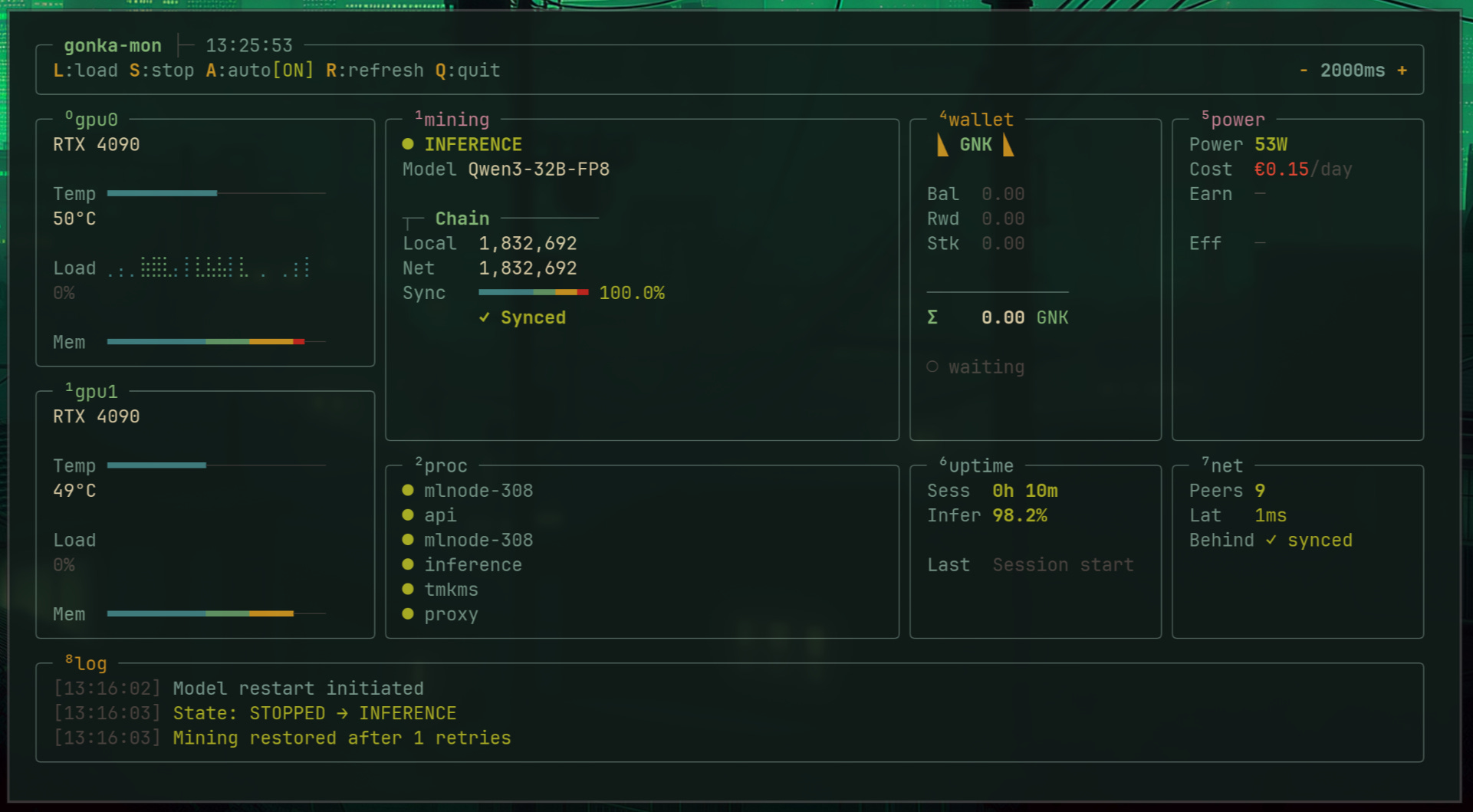
I also set up token mining on the Gonka decentralized network and wrote a complete Linux monitoring dashboard called gonka-mon. I’ve never been a developer. Not once in my life.
Here is how it looks:
My Gonka Mining Case: 547,000 Lines of Code, Zero Developers
Let me give you a concrete example. Last month I launched a complete distributed AI mining infrastructure. Not a toy project. A production system with a Cosmos-SDK blockchain, a decentralized API layer for AI task orchestration, and GPU-optimized inference nodes running 32-billion parameter models. On a POWERHOUSE PC.
The numbers speak for themselves: 954 Go files, 73 Protocol Buffer definitions, 1,059 git commits, 547,000+ lines of production code. The architecture includes custom blockchain modules for inference validation, collateral management, BLS threshold signatures, and a novel “Proof of Work 2.0” consensus mechanism where computational work serves actual AI workloads instead of being wasted on hash calculations.
Previously, a project like this would require a team of 10-20 engineers: blockchain developers, distributed systems specialists, ML engineers, DevOps. Weeks of studying Cosmos-SDK documentation. Months on Discord forums asking basic questions. Hiring consultants at $200/hour to debug consensus issues.
I did it with Claude Code in an Omarchy Linux terminal. No team. No consultants. No forum crawling.
Building gonka-monitor: From Zero to Production Dashboard
On top of that, I wrote gonka-monitor — a complete Linux monitoring system for tracking mining state, network health, and hardware status. Real-time GPU stats, blockchain sync progress, wallet balances, pending rewards. A btop-style terminal interface with 40-item history tracking for trend analysis.
The system includes an auto-restart watchdog daemon that monitors mining state via HTTP API and handles automatic recovery with exponential backoff. Cooldown management, systemd integration, proper error handling and logging. Everything a production monitoring tool needs.
1,437 lines of Python. Built in days, not weeks. The kind of operational tooling that separates hobby projects from production systems.
The old way? Hire a Python developer, explain the requirements, review their work, iterate through feedback cycles. Budget $5,000-10,000 and a month of back-and-forth. The new way? Describe what you need, let AI handle the implementation details, iterate in real-time until it works exactly how you want.
The YouTube Parallel
Marc Andreessen made a perfect analogy with YouTube. Fifteen years ago, the film and TV industry seemed over-saturated with content. Then YouTube democratized video creation, and something paradoxical happened—it turned out there wasn’t enough content. Users wanted more. Individual creators now outperform traditional media companies in engagement and revenue. The same pattern is unfolding with software products right now. Alexander Wang from Meta says kids should learn vibe coding. I say everyone should, any age, any background. Someone starting from zero can build a commercially successful app within a month. After six months of serious practice, they become more qualified than average employees—because entrepreneurs develop full skillsets including marketing, design, and product thinking, while employees remain cogs in a system.
The Writing on the Wall
Tech companies fired almost 150,000 people this year. The freelance development market is already contracting. Corporate development is next. And when developers mock vibe coders, they’re revealing their fear. The nervous laughter is a tell. Their entire professional identity is crashing down around them. They spent 5, 10, 20 years mastering code, and now AI does it faster and cheaper. The question becomes uncomfortable: what else can you do? Adapt or get replaced. The revolution is just starting, and by 2026-2027 we’ll see critical mass.
Great read. So true. Builder mode on