

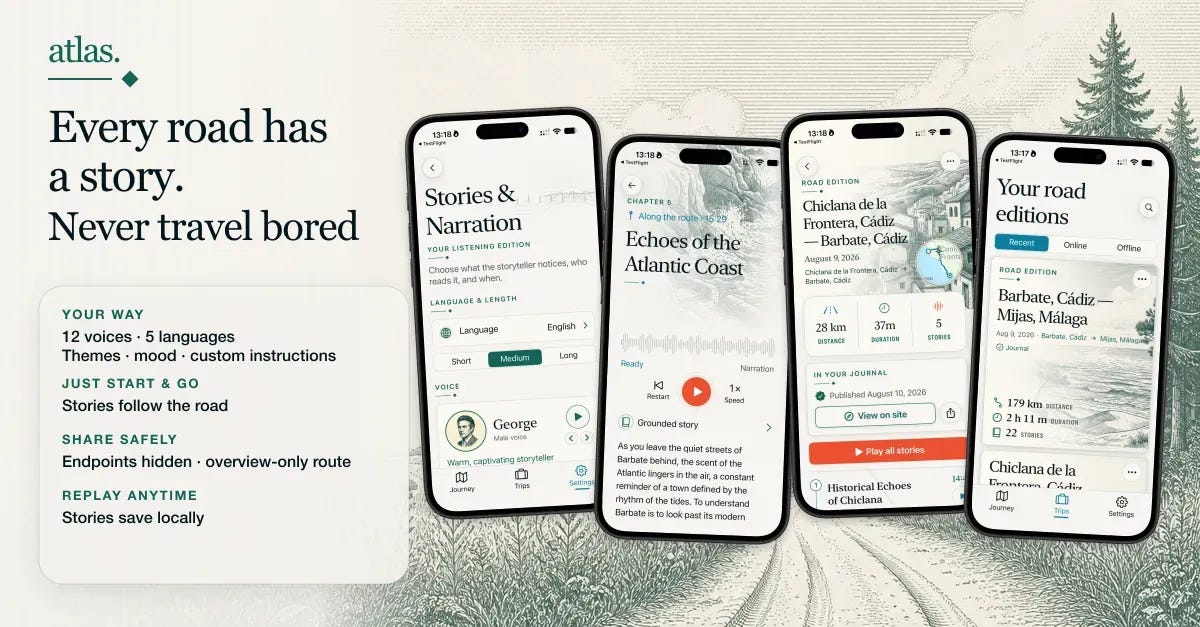
The beta is free until the end of August, for any number of journeys, at https://atlasdot.app. Listen to the average story you might encounter on your next trip → https://atlasdot.app/journal/mijas-and-the-peninsular-war-e2f3b6
How the idea found me
I was on the high-speed train from Madrid to Malaga. 260 km/h. Outside the window: fortresses on hilltops, rivers, tiny Spanish towns flashing past. I kept wondering what I was passing. That fortress had a name, a siege, probably a king who lost it, and I had no way to know.
On my home server runs Hermes Agent, my personal AI agent, reachable through Telegram messenger. So I improvised. I switched on Telegram live location sharing and typed: “tell me the stories of the most important places nearby.”
It worked. Astonishing stories poured in. Wars, kings, a town of 20 people with a past worth a film. For a stretch I felt like I had hacked travel itself.
Then it broke. Telegram pushes a fresh location every 5 seconds, and at 260 km/h my agent drowned in coordinate updates. It kept getting interrupted mid-story. Over roughly 100 km I got 6 stories, the rest of the time it fought the data stream and lost. Frankly, watching your own creation choke on GPS spam is humbling.
So I built atlas.
That failure was the best product brief I ever got. This had to be an app, not a Telegram hack. A second layer over the journey: the road gives you scenery, atlas. gives you the plot. I built it with AI-assisted coding plus my own product sense. It took over a month, roughly a hundred versions and two full design overhauls, and the current version is the one I finally love.
The heart of it is a speed-adaptive engine. The search radius grows with your speed, from about 1.5 km at a walking pace to 10 km on a motorway. Story cadence adapts too. And the app anchors each story where you WILL be when the narration is ready, not where you were when it started thinking. The problem that killed my Telegram agent became the first feature I designed.
ElevenLabs v3 narrates stories, the most expressive voice model there is, with 12 narrator characters. Languages: English, Spanish, Russian, Ukrainian and classical Arabic. If nothing documented is nearby, the app stays quiet instead of inventing filler.


Two modes cover the ground. Map mode narrates drives, works in CarPlay and puts a Live Activity on the Lock Screen. It ducks your Apple Music or Spotify for a story, then brings it back. Read mode is a silent text feed for trains and planes, no headphones needed.
You can publish a finished journey to a shared public atlas under a generated pen name like “quiet-kestrel”. The first and last kilometer gets trimmed, so the map never shows your home. Anyone can listen to published stories on the web. No account, no ads, no tracking.
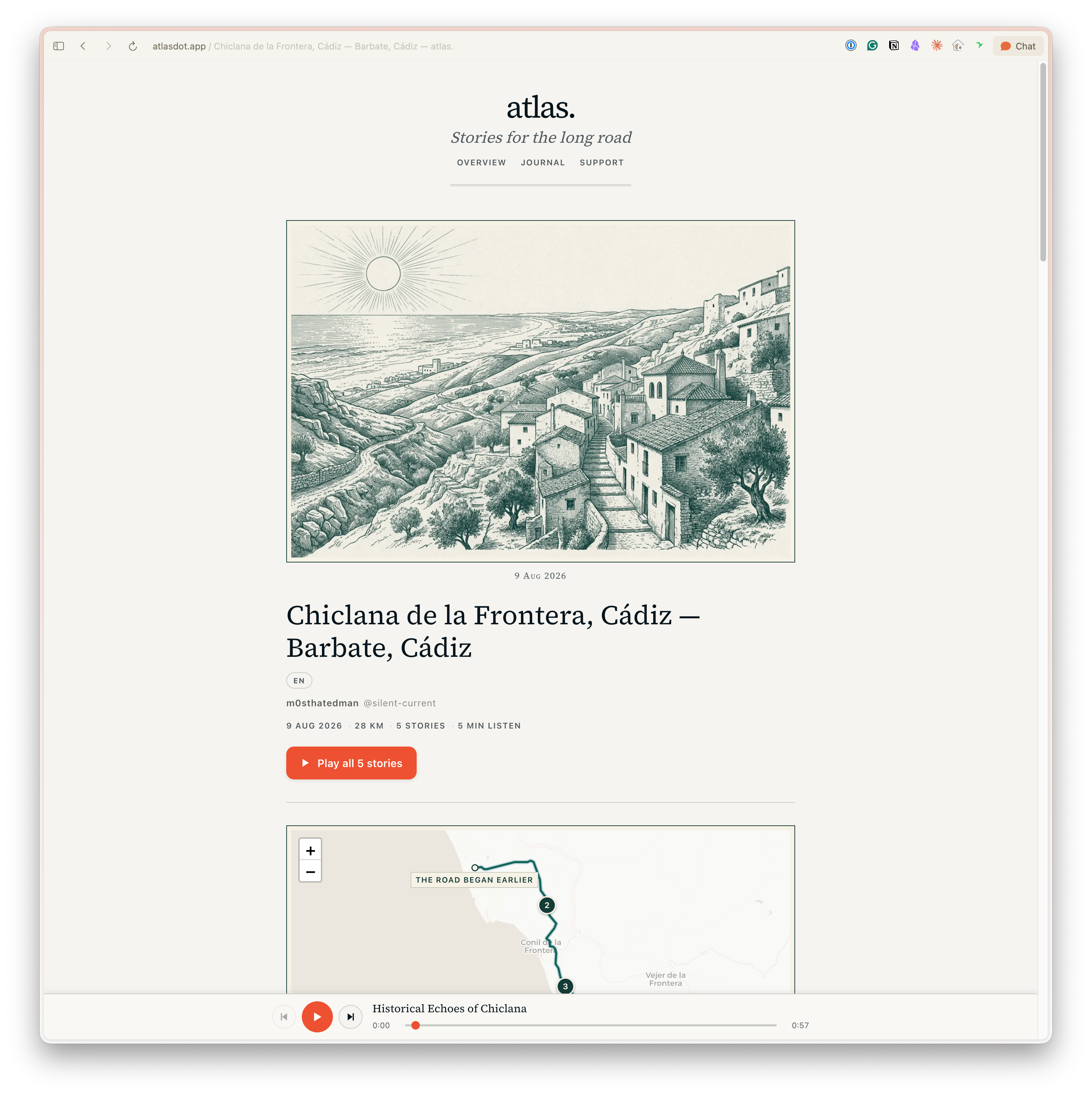
Since the train, I have driven all over Spain and part of France with it. From what I’ve seen on those drives, the best stories hide in places no guidebook bothers with. Testers in Ukraine, Dubai and a few other countries use it today. The feedback is mostly enthusiastic, which still surprises me. Now I want yours.
Try it before the end of August
The beta is free until the end of August. Any number of journeys, no caps. It runs on iPhone (iOS 26) and works on anything that moves: car, train, boat, motorcycle.
Go to https://atlasdot.app and tap the TestFlight link.
Install Apple’s TestFlight app if it asks you to.
Open atlas. inside TestFlight and go for a ride.
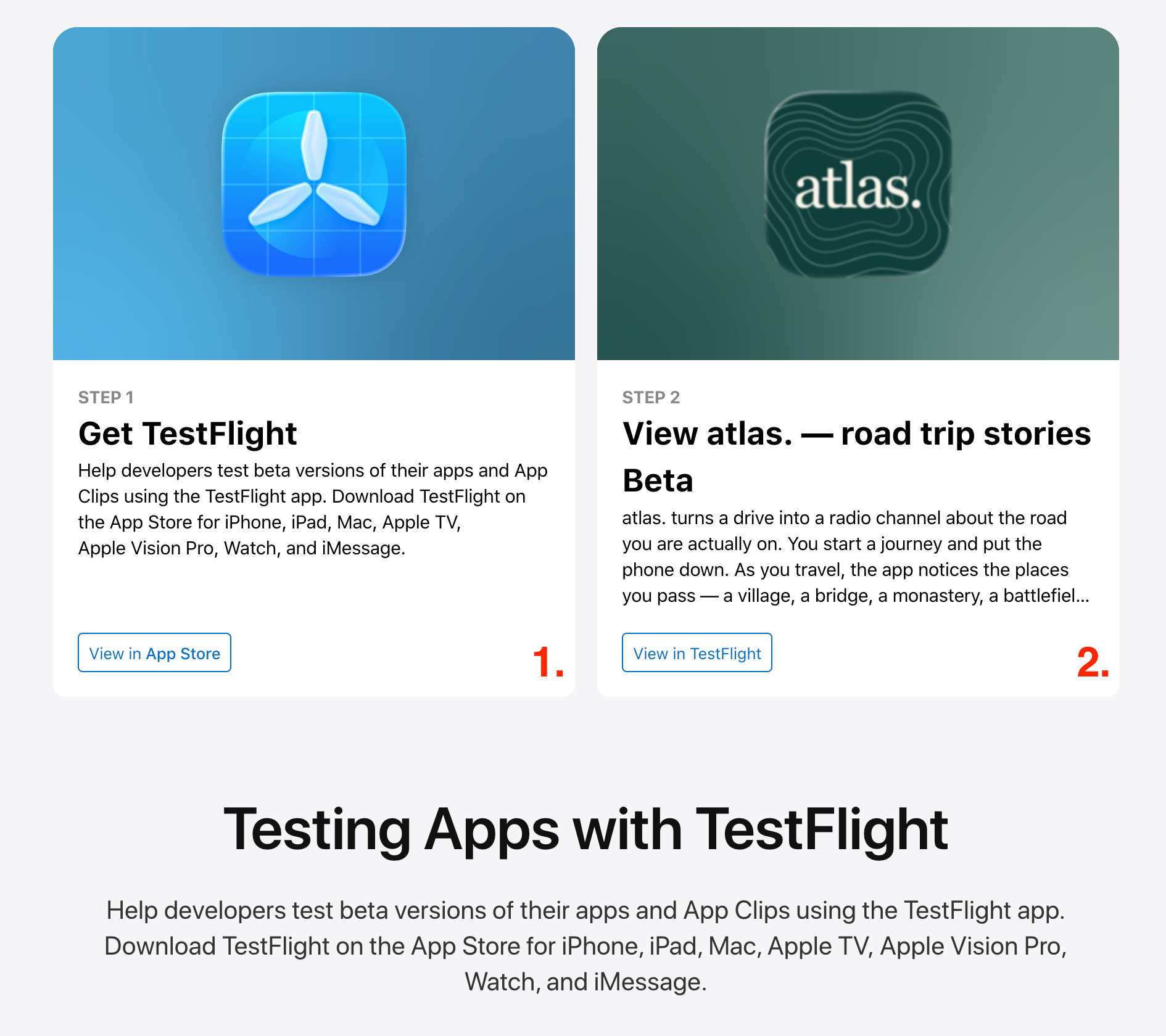
All it needs is internet and location access. That is the whole setup.
Want the technical story?
There is a whole second post hiding in how a CMO shipped an iOS app with AI agents. The speed math, the source pipeline, the two design overhauls, the parts I would never repeat. If you want it, say so in the comments or DM me and I will write it up.
And tell me this. What is the one road you drive on autopilot, never knowing what you are passing? Take atlas. with you next time and tell me which story it tells you first. I collect those now.
Try it here → https://atlasdot.app
Great idea! Will test this out