


Last month my marketing budget got cut by 27%. Season gone, Not trimmed — cut. Q1 was already behind. The gap wasn’t going to close itself.
The usual move: renegotiate, replan, try to do more with less. I did something different. I spent two days building a trading bot on a prediction market.
Not to escape the problem. To think about it differently.
Here are three things prediction markets taught me that no marketing framework ever did.
1. Price your beliefs, don’t just state them
When you place a bet on Polymarket, you don’t get to say “this looks promising.” You have to assign a number. Bitcoin above $85k by Friday — at what probability? You’re paying for that position. The cost makes you honest.
Most campaign briefs don’t work like this. Someone says “we think this channel will perform.” No one asks: perform at what confidence level? If you had to buy that position for real money, what would you pay?
I started running my marketing assumptions through this filter. If this were a Polymarket contract, what would I price it at? Turns out a lot of “strong hypotheses” price out at around 55%. That’s barely better than a coin flip. Not where you want to cut the budget.
Expected value isn’t a trading concept. It’s the thing you’re actually calculating when you allocate spend — you’re just usually doing it wrong.
2. Bet sizing matters more than bet selection
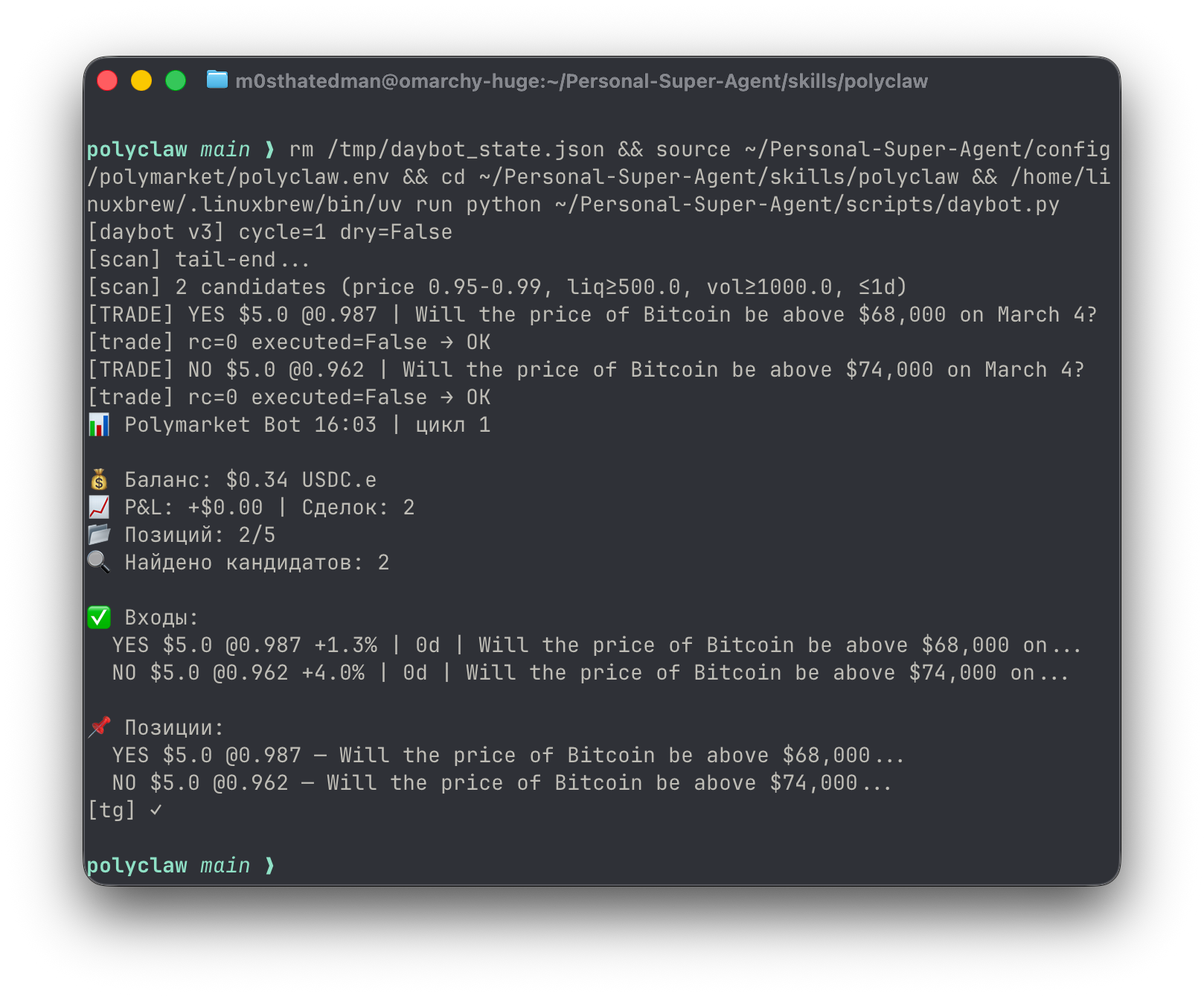
My bot made 9 trades in one session. The entry logic was decent. The position sizing was not. It deployed too much capital into single markets, and when two of them went sideways simultaneously, the losses stacked.
In trading this is called poor bet sizing. In marketing we call it “doubling down on what works.”
Kelly Criterion — a formula used by serious traders — says your position size should be proportional to your edge, not your conviction. Conviction can be high and your edge can still be small.
When I had to reallocate a 27% smaller budget across channels, I stopped asking “where do we believe in most?” and started asking “where do we have actual edge?” — meaning: demonstrated results, defensible data, a mechanism we understand. The answer was different from what my instincts said. And it was right.
3. When the market knows something you don’t
Here’s the part I didn’t enjoy: the prediction market was right more often than I was.
I built the bot because I thought I could spot patterns. RSI signals, news sentiment, and short-term momentum. The bot won some, lost some. After 48 hours: roughly break-even minus fees. The market had already priced in most of what I “knew.”
Marketing has the same dynamic. When you’re convinced your channel is undervalued, it’s worth asking: why isn’t everyone else seeing this? Competitors, agencies, benchmarks — they’re a kind of market. When the whole industry moves away from a channel, there’s usually a signal in that.
Contrarian bets are expensive to be wrong about. Be sure you have information the market doesn’t — not just a different opinion.
The actual numbers
I started with $50. Built the bot in one day with an AI agent running locally on my machine. The bot entered 9 positions. Two paid out correctly. The rest were technically broken — a state tracking bug caused it to hold both YES and NO tokens on the same market simultaneously.
Lost nothing significant. Spent about $1 in transaction fees learning that correct position tracking is harder than correct trading logic.
Same lesson applies to every marketing automation project I’ve run: the edge isn’t in the idea. It’s in whether your measurement is accurate enough to know if it’s working.
Try it yourself. Put $20 on Polymarket this week. Not to profit — to practice assigning real probabilities to things you usually just assert. It takes about three losing bets to stop saying “I’m pretty sure” and start asking “what exactly am I pricing here?”
If this was useful, subscribe. I write about what I’m actually running — the experiments, the bugs, and what held up....
Great read! Do you think you can win in a long run on poly market ?