


Felix Kjellberg (aka PewDiePie) got a black screen six times.
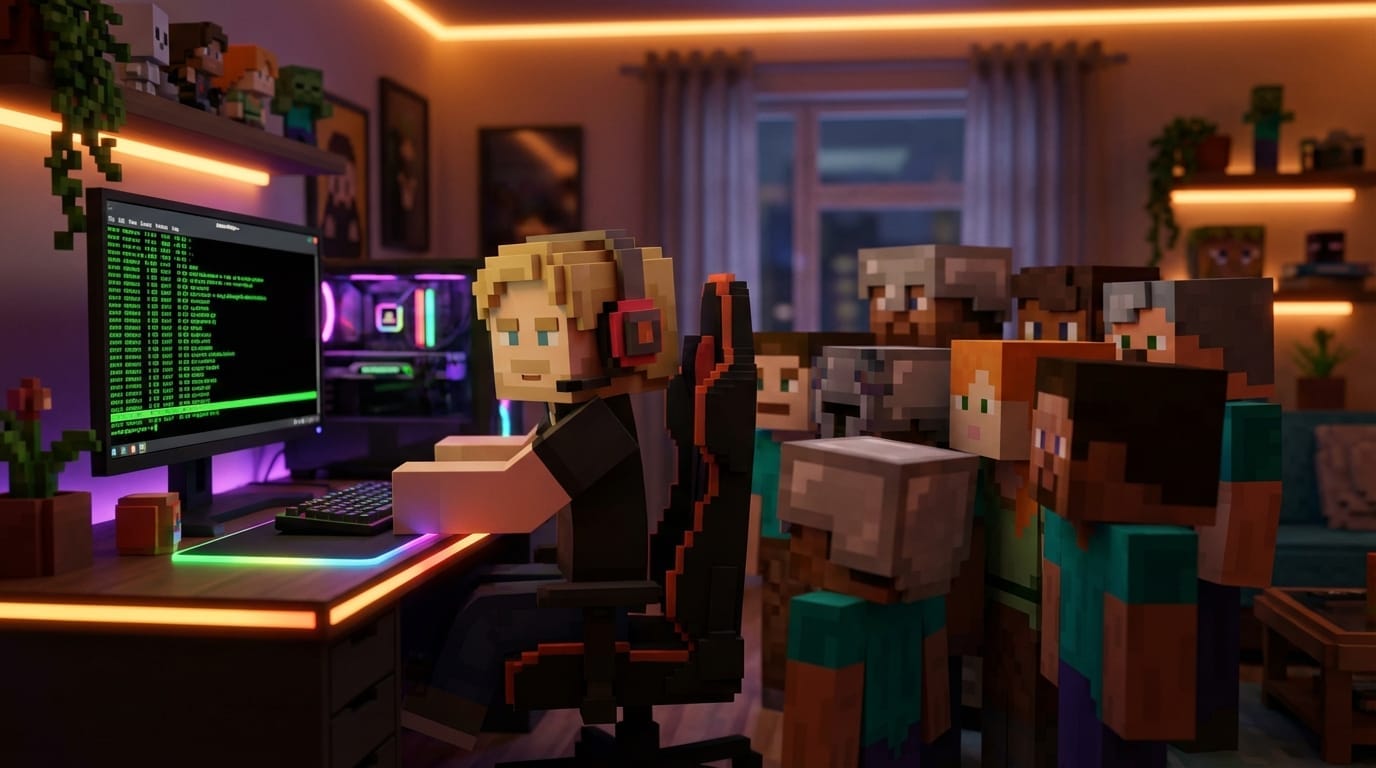
He was trying to install Linux on his Steam Deck. Each time — black screen. Each time — he tried something else. By attempt number six, most people would have closed the laptop, told themselves it wasn’t for them, and moved on.
He didn’t. He kept going.
7.6 million people watched that video.
His very first video was like this 15 years ago :) Feel the difference!
I don’t think they watched because Linux is interesting. I think they watched because something about watching a person refuse to quit — in public, in real time, while visibly frustrated — is deeply, uncomfortably resonant.
We know we’re supposed to push through. We almost never do.
The most important thing
Here’s the thing most learning content won’t tell you: the discomfort is not a side effect. It’s the mechanism.
When something breaks, and you don’t know why, your brain has to actually engage. When there’s no tutorial for this specific combination of broken things, you have to think. When you sit with confusion long enough that you start asking better questions — that’s when learning happens. Not before. Not at the comfortable part.
The error message isn’t a sign you’re failing. It’s the class.
ThePrimeagen — a developer who turned his career into content — made a video about this called Embracing Failing. His take, stated plainly: the people who actually get good at technical things are the ones who accumulate enough errors that they stop being afraid of them.
“I have become so accustomed to failure, you have no idea. I have graveyards full of garbage data I thought was the best.”
He says this like it’s a badge. Because it is.
The graveyard of bad attempts is the actual portfolio. Not the finished work. The finished work is just the surface. Underneath it is every broken thing that taught you how to fix it.
PewDiePie spent 18 months learning in public. Watch the sequence.
Felix Kjellberg’s transformation over the last 18 months is the best documented case study of learning-through-pain I’ve seen in the public eye. Not because he’s exceptional at it — but because he’s visible at it, and he doesn’t edit out the hard parts.
October 2024. I Drew Every Day for 365 Days — 6.7 million views. A full year of being bad at drawing. Publicly. The early work was genuinely terrible and he didn’t hide it. This established the template for everything that followed: show the process, including the parts that hurt.
April 2025. I installed Linux (so should you) — 7.6 million views. Black screen six times. Tries again. Eventually lands on a fully customized Arch system. His conclusion after weeks of frustration: “Open source is always the best source. [...] Finally free. I escaped the Windowscape.”
June 2025. I’m DONE with Google — 7.3 million views. He removes Google from his entire life. Self-hosted everything. GrapheneOS on his phone. More pain, more configuration, more broken things fixed one at a time. When it finally works: “Google is at my mercy for once. Feels good. [...] Amazing. Finally, I’m free.”
September 2025. help, I’m going through a midlife crisis... — 2.4 million views. The most honest one. Not a content strategy. Just a person saying: this is hard, I don’t know exactly what I’m doing, I’m in the middle of it.
October 2025. STOP. Using AI right now — 4.6 million views. He trains his own language model. It performs worse after his training. He says so directly. He doesn’t reframe it as a learning moment. It just happened, it was bad, he kept going anyway.
That last one matters. He ran a model that he made worse. He said so on camera. And then he kept working on it.
That is the whole lesson in one moment.
We built systems designed to remove the pain. That was the mistake.
The generation now learning — and honestly, most of us who learned anything in the last decade — grew up with frictionless everything. Instant answers. Tutorials optimized for zero confusion. Systems designed to remove every possible point of difficulty.
The error message became a product failure, not a learning signal.
The result: people who feel busy learning but aren’t actually learning. They’re managing the appearance of learning. Finding a clearer tutorial. Reading more theory. Waiting until they feel ready. Avoiding the broken state as if it’s a threat.
Here’s what Linus Torvalds — the person who built the operating system Felix spent weeks installing — said about this:
“I happen to enjoy doing things I’m not good at. Because that’s how you learn.”
Not “failure teaches you lessons.” Not “mistakes are opportunities.” Just: I like doing things I’m bad at. Because that’s how it works.
The pain of not knowing is not a warning. It’s an invitation.
Why 7.6 million people watched a Linux install
By every metric of content logic, that video shouldn’t have worked. No hook. No memes. No gaming. A notoriously difficult operating system. An audience built on completely different content.
It got 7.6 million views. And then something measurable happened outside the video.
Reddit’s r/linux community — 11,000 upvotes — documented the moment: “Pewdiepie picks a fight against Google, installs GrapheneOS to his phone, he even installs Archlinux into his Steam Deck.”1 The Linux Mint team published an official welcome in their project newsletter: “We have a new user! Welcome to Linux, PewDiePie!”2 A separate thread in r/linux noted that “Linux market share surpasses 6% — SteamOS and Pewdiepie brought a new hype to Linux.”3 There was even a r/linux4noobs thread titled “Please do NOT try Arch Linux just because PewDiePie did” — 2,900 upvotes — which is the community’s version of a welcome problem.4
What moved people wasn’t the technical content. It was watching someone they’d trusted for 15 years hit a wall — repeatedly — and not stop.
That’s more persuasive than any tutorial. The tutorial shows you how. Felix showed you that when it breaks (and it will break), you don’t stop.
The physics of it
Here’s what actually changes when you push through long enough.
You don’t gain confidence. That’s not quite right. You gain something more useful: indifference to the error state. You stop reading the broken thing as evidence of unsuitability. You start reading it as data. Where did the system and my understanding diverge? That’s all it is.
Once you’ve seen enough of the same broken thing, your brain builds a map. Not consciously. Just through repetition. You start recognizing patterns in how things fail. You make better guesses. You process problems faster — not because you’re smarter, but because you’ve been here before.
Every hurdle you clear becomes permanent. Every broken thing you fixed means that flavor of broken no longer scares you.
These compounds. Slowly at first. Then embarrassingly fast.
But it only starts compounding if you don’t stop when it hurts.
The practical part
If you’re learning something right now — code, design, writing, a language, a system, anything:
Stop optimizing for smooth. The tutorial that never breaks is fine for orientation and useless for learning. At some point, you have to get lost. The sooner the better.
Pick something real. Not a practice project. Something with stakes. Something where “good enough” isn’t actually good enough. Pressure changes what you pay attention to.
Read the error before you Google it. Actually read it. Try to understand what it’s telling you before you outsource the thinking. This one habit compounds more than most courses.
Set a failure quota, not a success quota. “I’m going to hit 10 problems I can’t immediately solve” is a better learning goal than “I want to build X.” The shift from output to process removes most of the psychological weight.
Stop hiding the graveyard. Your failed attempts aren’t evidence you’re bad at this. They’re evidence you’re doing it.
The real message
Felix didn’t become a Linux user because he’s technically gifted. He became one because he refused to stop when it got hard. Six black screens. Weeks of configuration. A self-hosted setup built error by error.
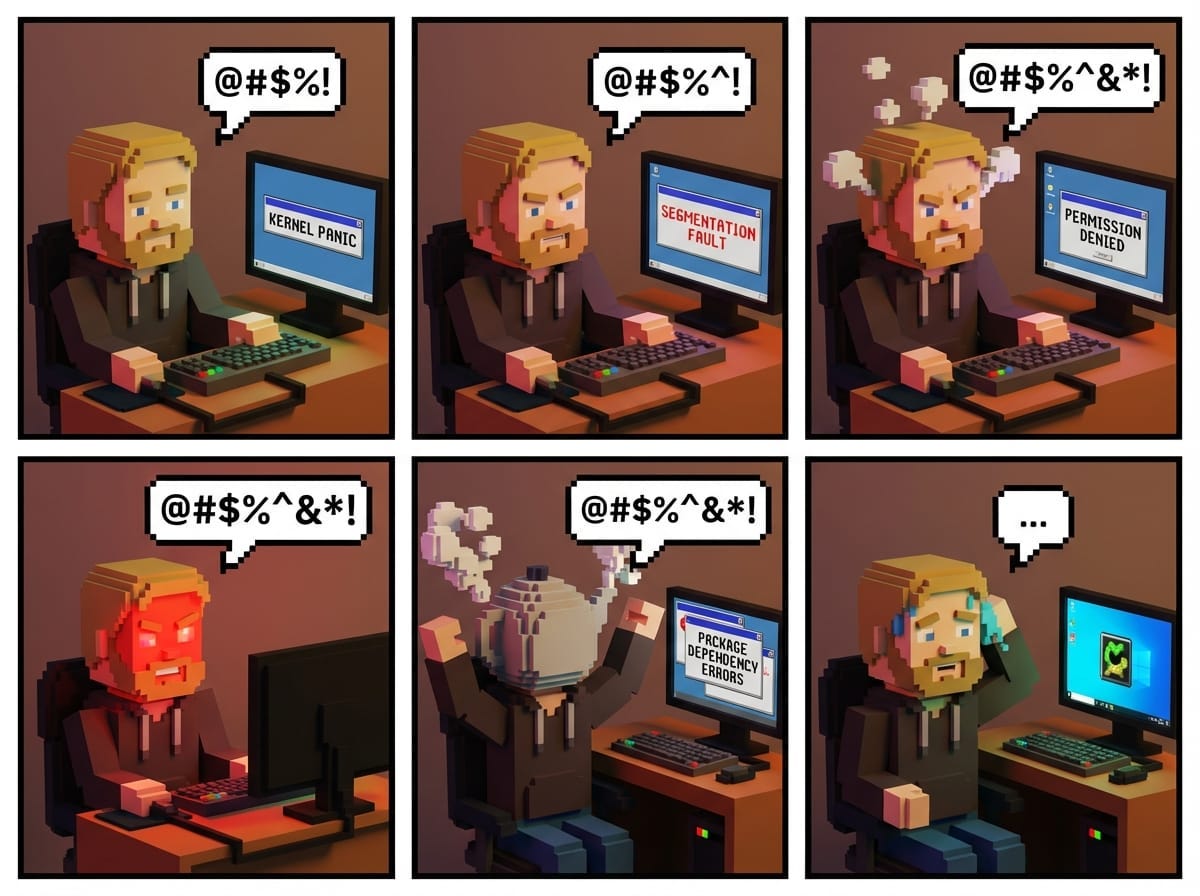
He got a midlife crisis video out of the experience. And 2.4 million people watched because somewhere in the title — “help, I’m going through a midlife crisis” — they recognized something true about what learning actually feels like when you do it honestly.
It feels like a midlife crisis. That’s fine. The feeling passes. The knowledge stays.
“I am way too stubborn for that. I just can’t. I don’t have it in me.”
That’s him. That’s also the whole answer.
Pain in learning is not a signal to stop. It’s a signal that something real is happening.
Stay.
I write about marketing, AI, and what happens when you actually pay attention. If something here was useful — share it.
Notes
r/linux, “Pewdiepie picks a fight against Google, installs GrapheneOS to his phone, he even installs Archlinux into his Steam Deck to host a Linux app.” 11,253 upvotes: https://reddit.com/r/linux/comments/1lld00e/
Linux Mint Blog, “Monthly News – April 2025” — official welcome from the Linux Mint team: https://blog.linuxmint.com/?p=4840
r/linux, “LINUX market share surpasses %6 and how mainstream distros ratio is.” https://reddit.com/r/linux/comments/1mlluen/
r/linux4noobs, “Please do NOT try Arch Linux just because PewDiePie did.” 2,948 upvotes: https://reddit.com/r/linux4noobs/comments/1k9rooq/