

…while some folks are getting replaced, others are quietly building five and six-figure businesses using the exact same technology. Not with hype. Not with courses about courses. With actual, revenue-generating work.
Read this before: AI is Replacing Real Jobs Right Now — Here’s What 1,734 People Say In The HUGE Reddit Thread
I scraped 184 Reddit posts from entrepreneur communities to find out what’s really working. And you know what? The people making real money aren’t the ones screaming about it on LinkedIn. They’re the ones who figured out that AI isn’t a business—it’s a power tool. And like any power tool, it’s only as good as what you build with it.
BTW, follow me on LinkedIn.
So let’s talk about the 10 ways people are actually making money with AI right now. Real examples. Real quotes. Real money.
1. Software Development (But Not How You Think)
The software contractors have stumbled into a golden window, and they know it. One developer put it perfectly:
“AI tools have rapidly expedited development but the normies accepting bids haven’t caught up. Tools like Claude Code have cut the actual hours I spend on many projects by ~5x and increased my enjoyment by at least ~10x. At some point they will stop accepting my bids (or expect more for less) but for now, 🤑🤑”
Translation: clients are still paying 2023 prices for 2025 productivity. This won’t last forever, but right now? It’s basically printing money.
Take the person behind paperbloom.com who built an AI-powered wrapping paper generator.
“We launched this week and it is already bringing in thousands—it’s been almost 2 years in the making so we’re pretty pumped to see this quarter through!!”
Two years of development work that probably would’ve taken five years without AI. That’s the real edge.
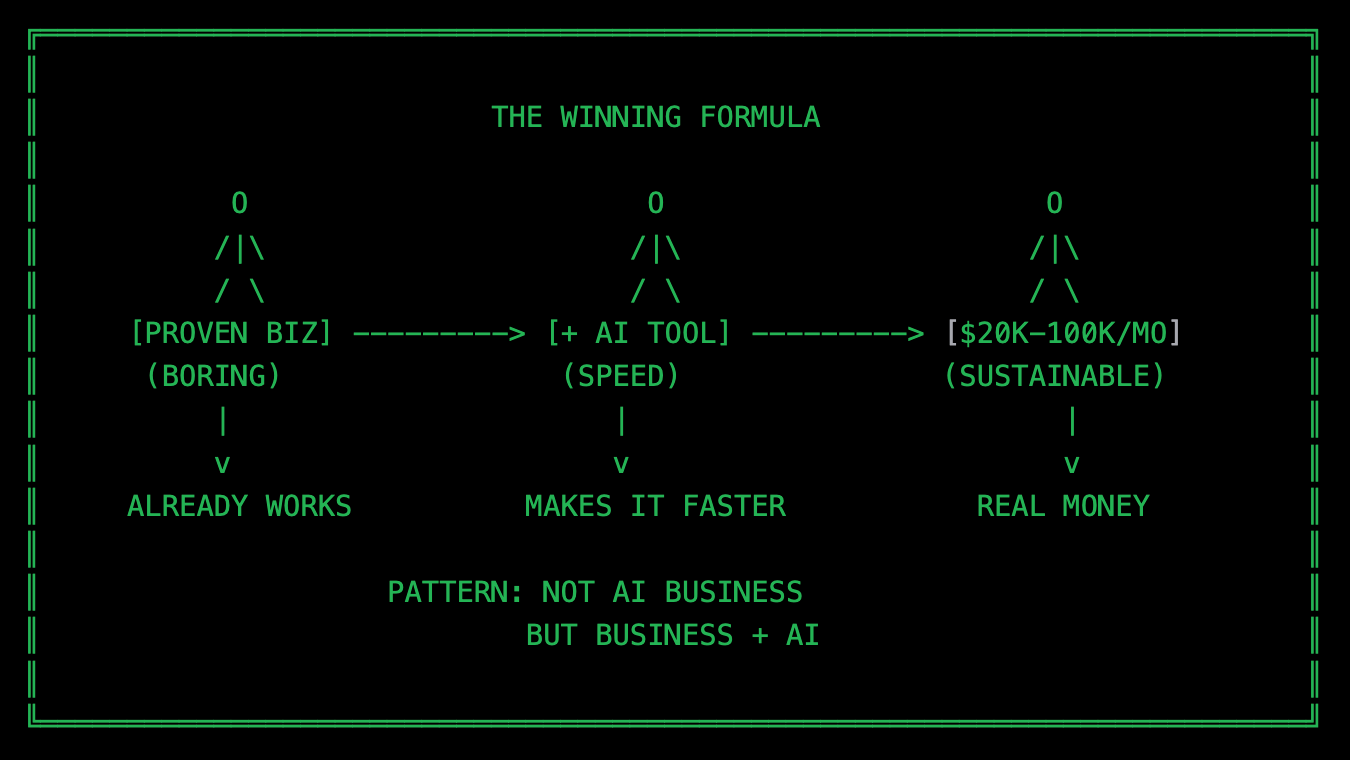
The pattern here isn’t “build an AI product.” It’s “use AI to build products faster than humanly possible.”
2. Consulting and Services (The Boring Business That Prints Money)
One comment nailed it:
“If they’re using AI to run a successful 6-7 figure business reviewing and rewriting policies and handbooks for companies for example why would they tell us? Get creative and figure out how to plug AI into tried and true business models that are already proven. Especially boring b[usinesses]...”
Boring businesses. That’s where the money is. Not flashy AI startups. Boring compliance work. Policy reviews. Handbook rewrites. The stuff nobody wants to do but everyone needs done.
Someone else dropped this gem:
“Got a friend who runs an SEO Agency, does £20k p/mo. Net margins are about 80% and AI has massively sped up all of his processes.”
Twenty thousand pounds a month. Eighty percent margins. SEO isn’t sexy. But it pays.
The insight? “Most people making money with AI right now aren’t ‘selling AI,’ they’re just using it to do what already makes money, but faster.”
3. Video Production (The Adobe Stock Gold Rush)
Here’s an interesting one. Someone’s earning $30-40K a month from Adobe Stock after uploading AI-generated images for 5-6 months. It's not life-changing money, but it's completely passive. The real success? Their YouTube channel, which got monetized in 2-3 months and is now making over $50K a month.
The strategy is brutally simple: “Buy some adobestock, come up with something content related, feed it into AI with prompts, load AI drivel into YouTube, profit.”
Is it high art? No. But does it work? Apparently yes. And beforee doesn’t monetize AI content”—one creator quickly shut that down: “Read the actual policy itself, don’t listen to others. It never says AI content can’t be monetized. Also, my AI channel got monetized.” you say “YouTub
The platform doesn’t care if you used AI. It cares if people watch.
4. Automation (The Invisible Money Maker)
This one’s less visible because automation isn’t something you sell—it’s something you do. “It makes sense to leverage AI to enhance existing workflows rather than trying to sell it as a standalone product. Efficiency is key, and using AI as a tool can help streamline processes and increase output.”
The people making money here work for companies that adopt AI. “Once preliminary training is done for basic productivity gains (including linking data sources etc), it’s all about process mapping and figuring out where AI and automation can fit in well.”
They’re not building automation tools. They’re implementing them for companies that have no idea where to start. It’s consulting, but with a technical edge. And companies will pay serious money to someone who can actually make their workflows faster.
5. E-commerce (Old Business Model, New Speed)
The e-commerce folks aren’t reinventing the wheel. They’re just spinning it faster. AI cuts ad costs. AI writes product descriptions. AI generates images. AI does customer service.
One person summed it up:
“Content guys pump 10x more videos, ecommerce guys cut ad + copy costs, freelancers deliver faster and take more clients. AI is just the new power tool, not the business itself.”
That’s the pattern across all categories. AI isn’t replacing the business. It’s supercharging it.
6. Design (Custom Everything, At Scale)
The custom wrapping paper tool I mentioned earlier? That’s design at scale. AI-generated patterns, personalized for each customer, delivered as physical products. It’s mass customization—something that was economically impossible before AI made generation cheap.
Another angle:
“At work we use an AI tool trained on patents. It just does great stuff and we pay quite some money for it.”
Specialized design tools for specific industries. Not “generate a logo” generic stuff. Deep, industry-specific applications.
The money’s in the niche. Always has been.
7. AI Assistants and Voice Agents (Infrastructure Nobody Sees)
This one’s clever.
“I focus on a specific niche. Let’s take doctors. They want their patients to be booked in their calendar. So we make an AI appointment scheduling voice agents and WhatsApp chatbot and then make a custom dashboard using coding tools and connect/authenticate it with their calendar with the appointments booked. Analytics and KPI so they can also see the ROI.”
It’s not selling “AI chatbots.” It’s selling “doctor appointment booking systems that happen to use AI.” The customer doesn’t care about the technology. They care about filled calendars.
Someone else is making six figures with “AI-powered content, chatbots, and voice agents.” But notice they stayed consistent and focused on creating rather than “chasing every new AI model trend.”
The technology changes every month. The problems stay the same. Solve the problems.
8. Content Creation (But Make It Smart)
The content creators who are succeeding aren’t just producing generic blog posts. They’re leveraging AI to keep up volume without sacrificing quality. “Content guys pump 10x more videos”—but the smart ones are still editing, curating, and adding their voice.
One person mentioned they’re using AI to scale their content production across platforms. Not replacing creativity. Amplifying it.
The losers? The ones trying to fully automate everything and wondering why nobody engages. The winners? The ones using AI as a co-pilot, not a replacement.
9. Education (Yes, But Not How You Think)
Look, everyone jokes about “people making money with AI are basically selling courses on AI.” And yes, that’s true for the visible folks. But look deeper and you’ll find people actually teaching useful skills, using AI to grow their reach.
The difference? One group is selling the dream of AI riches. The other is teaching actual skills (programming, marketing, design) and using AI to handle the grunt work of course creation, student support, and content updates.
Guess which one has better retention rates?
10. Research and Analysis (The Quiet Professionals)
This might be the least flashy category, but it’s one of the most solid.
“I work in the industry on AI adoption and engagement and, once preliminary training is done for basic productivity gains (including linking data sources etc), it’s all about process mapping and figuring out where AI and automation can fit in well.”
These are the consultants who come in, analyze your business, figure out where AI fits, and implement it. They’re not selling AI. They’re selling efficiency. ROI. Competitive advantage.
Someone else mentioned patent research tools their company pays “quite some money for.” That’s B2B SaaS. That’s recurring revenue. That’s the kind of boring, profitable business that funds someone’s beach house.
The Real Pattern
After reviewing these examples, one thing is clear: nobody’s getting rich selling “AI” as a product. They’re making money by using AI to improve existing work—doing it better, faster, and cheaper.
The people profiting found something that already works—SEO agencies, software development, e-commerce, consulting—and integrated AI into it. They’re not AI entrepreneurs; they’re entrepreneurs who use AI.
The best advice from the entire dataset? “Get creative and figure out how to plug AI into tried-and-true business models that are already proven. Especially boring businesses.”
Boring businesses. Proven models. AI as the accelerant, not the fuel.
That’s how people are actually making money in 2025.