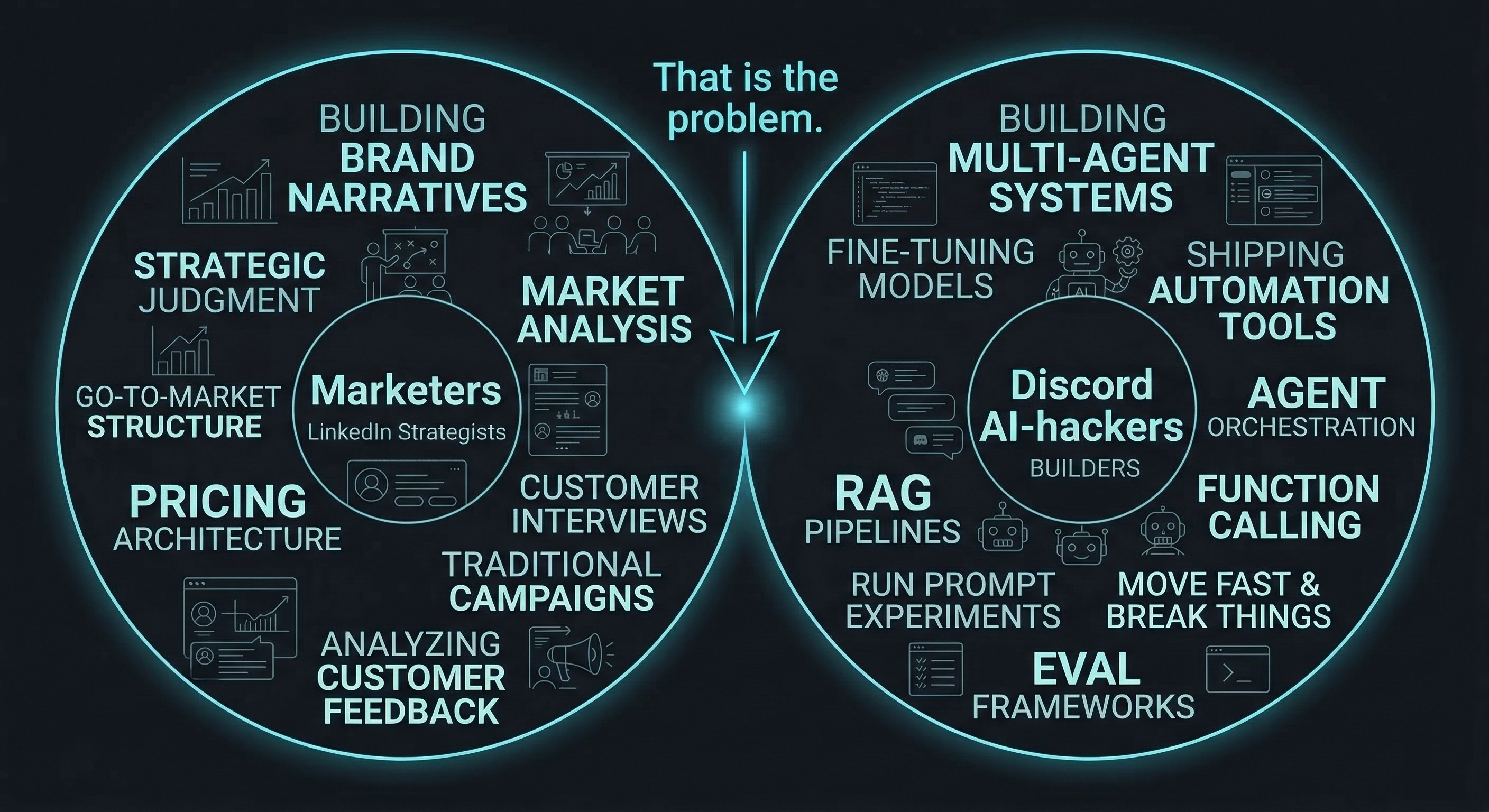
I find this funny. But I also think it points to something real.
Two rooms, zero overlap
Here’s what’s actually happening right now, across two very different communities:
In Discord — Hugging Face servers, AI agency communities, agent-builder channels — there are tens of thousands of people fine-tuning models, shipping automation tools, building multi-agent systems, running prompt experiments, and figuring out what AI can actually do in production. They move fast. They break things. They share findings in threads that disappear in 48 hours and never make it to a newsletter.

On LinkedIn — the feed that senior marketers actually check — there are thought leaders posting about “leveraging AI for content strategy.” Sharing articles about which tools will “transform marketing in 2026.” Explaining AI to audiences who nod along and save the post.
These two groups are not talking to each other. And both are paying for it.
What builders are missing
The Discord builders can ship. They understand the technical layer — agent orchestration, function calling, RAG pipelines, and eval frameworks. They know what’s actually possible right now, not just what’s in the press release.
What many of them can’t do: explain why it matters to a customer. Write positioning that lands. Understand why a technically impressive automation doesn’t convert. Figure out which problem is worth solving before building the solution for it.
Marketing judgment is slow to develop. It comes from years of reading customer interviews wrong, launching campaigns that flopped despite the brief looking solid, watching a price change kill retention in a segment you didn’t model. You can’t shortcut it with a GitHub repo.
So builders ship things that are technically interesting and commercially vague. They optimise for capability, not for the gap in the market.
What strategists are missing
Senior marketers have the judgment. They know how to read a market, build a brand narrative, structure a go-to-market, set a pricing architecture. They’ve been in enough rooms to recognise the difference between a good idea and a fundable idea.
What most of them don’t have: direct exposure to what’s actually being built right now, at the execution layer.
And this matters more than it sounds. Because the execution layer is being rebuilt from scratch.
The assumption that “we’ll hire developers for the technical parts” holds when the technical parts are stable. When the infrastructure is in motion — when the tools for automating research, content, analysis, and coordination are changing month by month — not understanding that layer means making strategic decisions with wrong assumptions about what’s possible.
The strategists are optimising for a distribution channel that’s quietly becoming less relevant. Running campaigns for traditional search while AI-referred traffic grows 527% year-over-year. Building SEO strategies without realising a WAF is blocking every AI crawler. Hiring teams for tasks that will be automated before the new hire finishes onboarding.
Why they don’t meet
Part of it is pace. Discord moves in hours. LinkedIn moves in weeks. By the time a technical insight becomes a LinkedIn carousel, the builders have already moved past it.
Part of it is identity. “Marketer” and “builder” feel like different job descriptions, different kinds of people. The assumption is that strategy and execution are separate disciplines requiring separate humans.
Part of it is that the overlap — people who have genuine strategic judgment AND direct technical fluency — is genuinely rare. Most people develop one or the other. Crossing over requires time that most senior professionals don’t have, and intellectual humility that’s hard to maintain after years of expertise in one domain.
What happens when they do meet
The interesting cases right now are people and teams where both layers are present. Not always in one person — sometimes it’s a strategist who understands enough to have a real conversation with builders. Sometimes it’s a builder who’s spent enough time on commercial problems to know what’s worth shipping.
What they share: the ability to ask “what problem does this solve?” and “can we actually build this?” in the same conversation, without one question killing the other.
The output is different. Not just technically impressive. Not just strategically coherent. Actually useful — and actually buildable.
One example from my own setup: I built an AI agent system for marketing operations. Named agents, role specs, orchestration logic. The strategic layer — knowing what each agent should optimise for, what the actual output should look like, how to measure whether it’s working — required years of marketing judgment. The execution layer — building it, debugging it, making it run — required direct technical engagement that no strategy document could replace.
Neither layer alone would have produced anything worth using.
The window
Only 23% of marketers are actively working on AI visibility and automation. The builders largely lack the commercial frame to turn their capabilities into marketed products. The strategists largely lack the technical fluency to know which capabilities to bet on.
That gap is a window. It won’t stay open.
The people who figure out how to operate in both rooms — or how to build genuine bridges between them — are going to have an asymmetric advantage for the next few years. Not because they’re smarter. Because they’re less siloed.
Happy to in the both of the worlds, but it is crazy hard.