

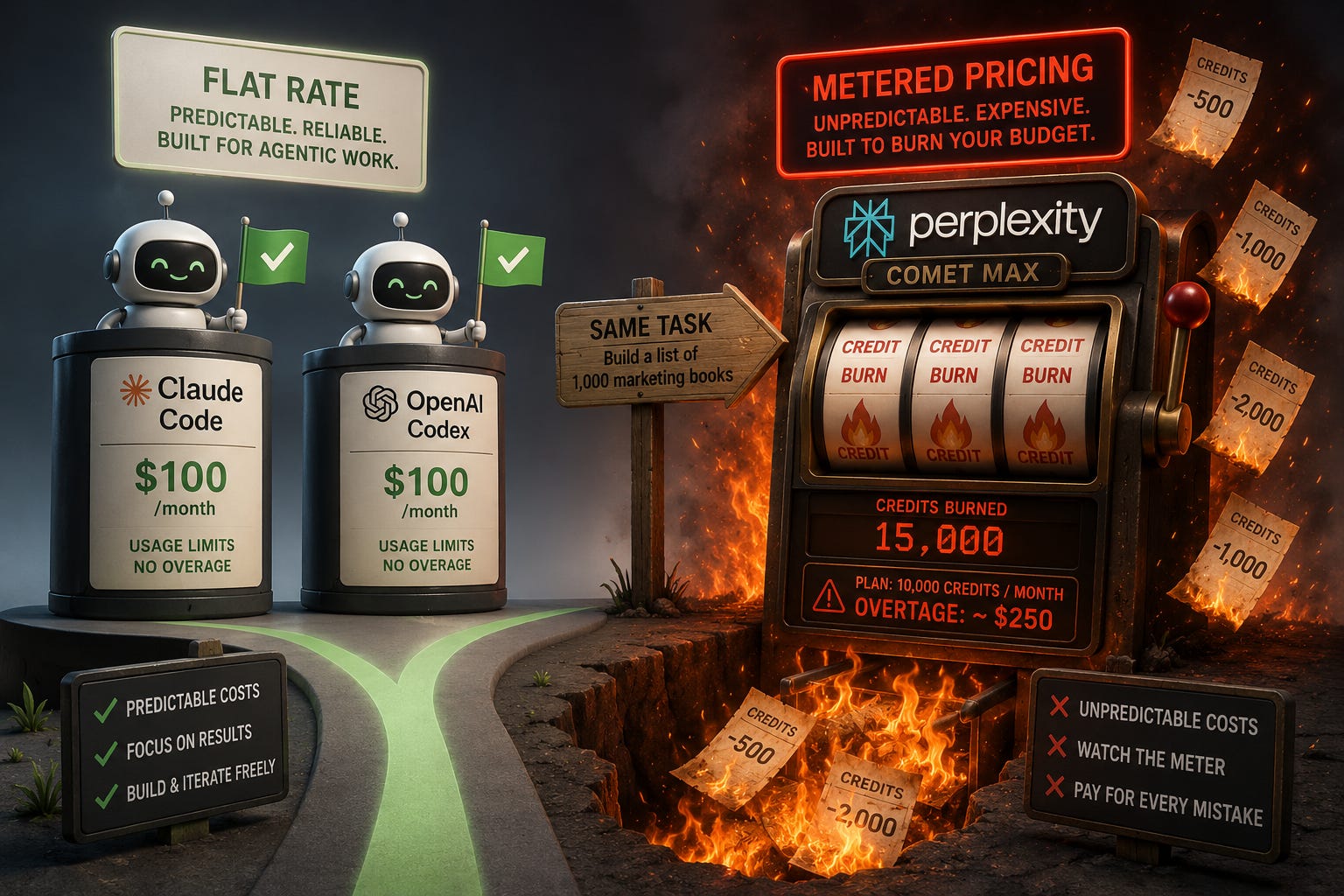
Same task. Three agents. Three pricing models. The numbers tell a story most AI vendors don’t want you to see.
The Test
I asked three agents to build a curated list of 1,000 best marketing books. Real research, real categorization, real sourcing. Not a one-shot prompt. A proper agentic task that runs for hours.
The result from Perplexity Computer you'll see at the end of the article ↓
Three contestants:
Claude Code, $100/month Max plan
OpenAI Codex, $100/month plan
Perplexity Computer, $200/month Max plan
Same job. Different worlds.
The Results
Claude Code finished in 40 minutes. Burned 17% of my 5-hour context window. Job done. Zero overage. Still inside my flat $100 fee.
OpenAI Codex finished too. Took longer. Used 51% of my daily 5-hour quota. Still inside the $100 plan. No extra charge.
Perplexity Computer ran for 5 hours. Burned 15,314.24 credits. The Max plan ships with 10,000 credits per month. So one task ate 1.5 monthly allowances in a single afternoon. The save came from the bonus credits you get upon registration.


In real money? Roughly $250 for one task. On a $200 plan. For a job Claude did in 40 minutes inside its monthly cap.
Sound familiar? It should. Every “pay-as-you-go” AI product works this way.
Read my previous article, where I shared some thoughts on Perplexity's agentic perspective without a Big Model of its own.
The Perplexity Dilemma: Lessons of The Middleware King

On February 25th, Perplexity shipped Computer. Not a laptop. A cloud-native multi-model orchestration system that routes work across 19 frontier models. It spawns sub-agents. It persists memory for months. It delivers finished artifacts while you sleep. It runs Claude Opus 4.6 as its reasoning core, Gemini for deep research, Grok for speed, GPT-5.2 for …
The Pricing Trap
Token-based, credit-based, and API-call pricing is mathematically broken for agentic work. Agents loop. They retry. They search, read, summarize, re-read, plan, re-plan. A simple task spawns thousands of tool calls under the hood.
You can’t predict the cost. You can’t budget for it.
I’ve seen this pattern across every vendor selling agents on metered pricing. One task runs hot and burns a month of credits. Vendor sends you a bill you didn’t authorize. You disable the agent. You go back to doing it manually.
That’s not a product. That’s a slot machine with a corporate logo.

The Math
Let’s be honest. A senior researcher in Eastern Europe costs $3,000 to $5,000 a month. Full-time. Real human. Asks clarifying questions. Doesn’t loop forever on a bad prompt.
If your agent costs $250 per task and you need 20 tasks a month, you’re at $5,000. Same money. Worse output. No accountability.
The reality is most metered agents are more expensive than hiring people. And they don’t even solve the problem better.
One month of heavy use, side by side:
Claude Code Max: $100 flat, unlimited tasks inside daily limits
Codex $100 plan: $100 flat, unlimited inside daily limits
Perplexity Computer Max: $200 base plus ~$1,500 in overage at my usage rate
Which one is the business product? Which one is the trap?
Why Flat Rates Win
Agents need to run free. They need to retry, branch, fail, recover. That’s how they work. The moment you tax every loop, you’re paying for the agent’s mistakes too.
Flat-rate plans with usage limits are the only sustainable model. Vendor absorbs the variance. You know your monthly cost upfront. Agents are incentivized to be efficient on their side. You’re not afraid to use it.
When I run Claude Code, I don’t think about cost. I just use it. That’s the whole point of an assistant. The moment I start watching a credit meter, I stop using the tool. And a tool I don’t use is worth zero.
Trust my experience. I’ve burned real money on metered AI products. Twice. The second time I felt stupid.
The Rule
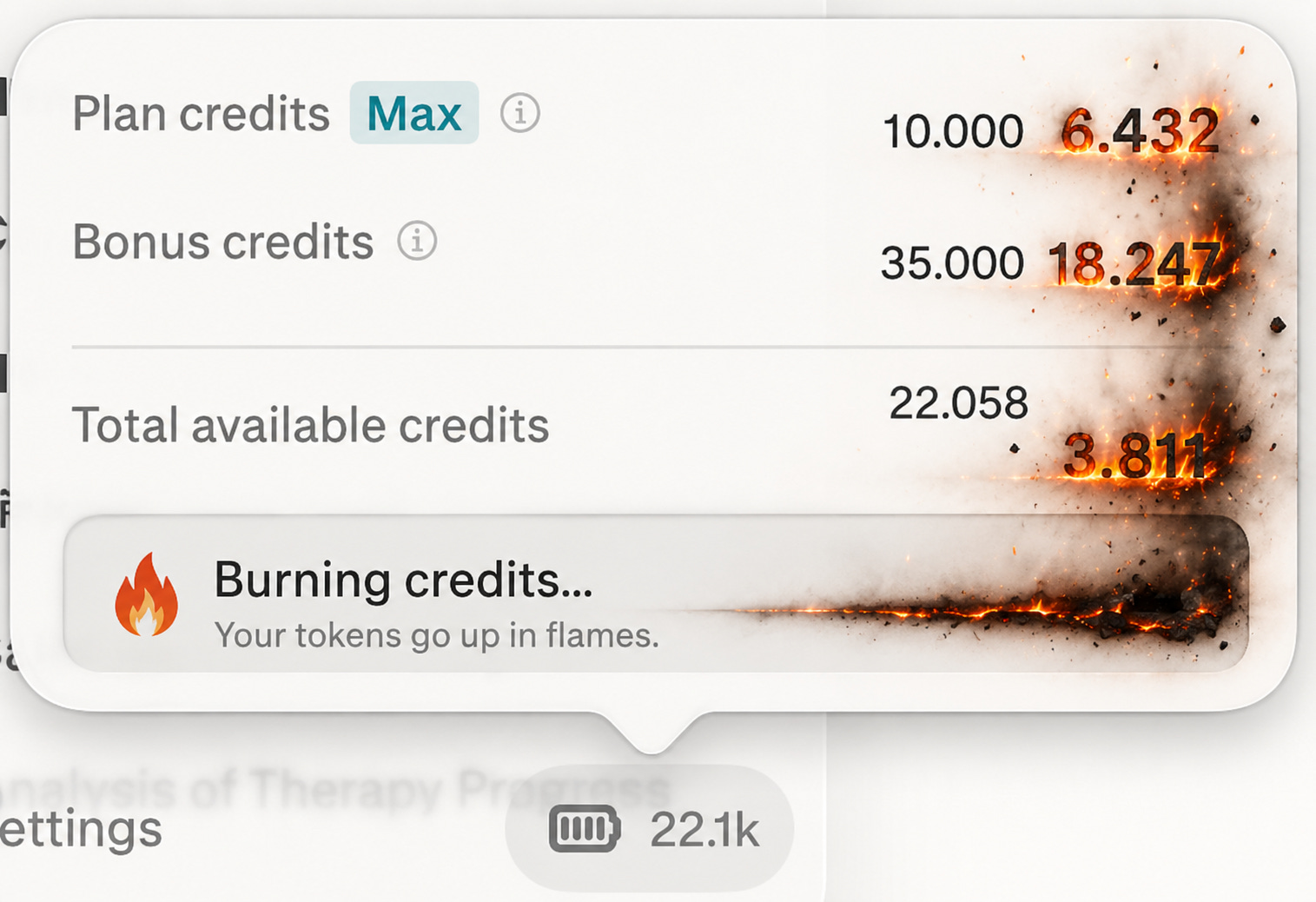
Here’s my rule from now on, and I’m not flexing on it:
Never use an agent priced by tokens, credits, or API calls. Only use agents on monthly flat rates with usage limits, but no money overage. So skip LLM APIs, Perplexity Computer, Manus for heavy tasks, and Genspark as well.
If a vendor can’t ship a flat plan, they don’t believe in their own product. They’re hedging their bet on your wallet.
The winners are clear. Claude Code and OpenAI Codex have figured out the right model. They cap your usage, not your bank account. Everyone else selling agents on credit meters is selling you a casino chip and calling it a productivity tool.
Bottom line. If your agent task can cost $250 on a $200 plan, you don’t have a product. You have a billing surprise waiting to happen.
Before you sign up for the next shiny agent platform, ask one question. What’s the worst-case bill for one heavy task? If they can’t answer, walk away.
What’s your worst pay-as-you-go AI bill so far? I’d bet most people reading this have a story.
P.S. And the result from Perplexity Computer.